
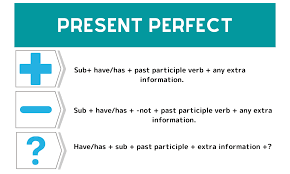
When to use the Present Perfect Tense in English
In this lesson, we are going to look at WHEN to use the present perfect tense, in what situations do we need to use it.
In general, the present perfect tense links the past to the present in some way. Let’s look at the different ways we use the present perfect tense in English:
Unspecified Time – Life experiences
The present perfect tense is used when the event happened at an unspecified time in the past.
We don’t say or specify WHEN something happened, the time in the past is not mentioned.
This is typically for things we have done in our lives (life experiences) but without saying exactly when they happened.
Look at this example:
- I have been to Spain.
This means I went to Spain at some unspecified time in the past.
I did not say when I went to Spain. It is something I have done at some moment in my life.
Look at this sentence in the past simple tense:
- I went to Spain in 2019.
(Here, we have specified a time in the past – the year 2019)
Let’s look at some more example sentences:
- I’ve met the President. (I don’t say when it happened)
- She’s won many awards. (Again, we don’t say when)
- We’ve done this before. (Before now, but we don’t specify when)
- He has appeared on TV. (We don’t specify when)
Remember that we generally use contractions in spoken English.
I’ve met … She’s won …
With unfinished time periods – Unfinished situations
We use the present perfect tense to talk about periods of time that have not finished such as today, this week, this month.
Today has not finished.
This week has not finished.
This month has not finished.
This year has not finished.
Look at these examples
- I’ve been very busy this week. (This week has not finished)
- She’s had five cups of coffee today. (Today hasn’t finished)
- We’ve spent a lot of money this month. (This month has not finished)
- He has studied a lot this year. (This year hasn’t finished)
Remember had is the past participle of to have.
You HAVE a cup of coffee. (Or you drink a cup of coffee … but had sounds more natural)
Compare the following sentences:
- Yes, I have seen Jack at work this morning.
(This morning hasn’t finished so we use the present perfect tense)
- Yes, I saw Jack at work this morning.
(The morning has finished; it is now the afternoon – so we use the past tense)
Can you see the difference?
A finished event connected to the present
This is an action that happened in the past (often recent past) but has a connection to now or a result in the present.
- I have fractured my wrist so now I can’t play tennis.
(The accident happened in the past but as a result or consequence now … I can’t play tennis)
Here are some more example sentences:
- I’ve eaten too much. (The result, my stomach is full and I don’t feel very well.)
- They’ve studied for the test. (Result, they are likely to pass the test now)
- He’s lost his keys. (And now he can’t enter his apartment)
- She’s had some bad news. (The consequence, now she is sad.)
Now look at this example:
- Somebody has let the dogs out of the house.
(This happened in the past and now (the result in the present) the dogs have escaped)
HOWEVER, if you want to know WHO caused something, we use the past simple tense… so we say:
- Who let the dogs out?
(I bet the tune is in your head now.. ha ha ha!)
To express completion or achievement
This activity has (recently) been completed or done.
Someone has just achieved something.
Used to ask someone if something has been done or finished.
Look at these examples:
- I have finally finished my homework! (I have just completed it)
- Has he tidied his room? (I want to know if it has been done)
- We have just won our league. (We achieved this!)
- Have you written your essay yet? (I want to know if you have done it)
How long a situation has lasted until now – FOR / SINCE
The present perfect tense can be used to say how long something has lasted (the duration of something) until the present moment.
In this situation, we use FOR + Length of Time
- I have lived in this country for 5 years. (5 years in total up until today)
You can often use the present perfect continuous tense for the same situation.
- I have been living in this country for 5 years.
We will compare these two tenses in another lesson.
Let’s look at these examples:
- We have known each other for many years.
- They have rented our house for two months.
- She has been in Spain for three weeks.
- He’s worked with me for ten years.
Notice how all of these sentences have FOR + a length of time.
We can also use the preposition SINCE when we give the beginning point (in the past) of the event that continues from then until today.
Look at this sentence again:
- I have lived in this country for 5 years. (This means 5 years in total up until today)
BUT, if you know when this started (and it still continues today) you can use SINCE + Date or Start Time
- I have lived in this country since (It started in 2017 and continues to the present day)
Let’s look at some more examples:
- I haven’t eaten anything since
- We have rented this house since
- She has worked here since
- He hasn’t been at work since
Repetition of something – Habitual Actions.
The present perfect tense can be used when an activity has been repeated many times up until now and it is likely to continue to happen. These activities could also be habitual actions in the past.
- I have called him ten times and he still hasn’t answered the phone.
I have called him … this has been repeated ten times up until now.
Notice this part: … he still hasn’t answered …
We used STILL and the perfect tense because the situation continues until this moment, much longer than expected. I expected him to have answered the phone before now.
We will see more about STILL in the next lesson about adverbs with the present perfect tense.
- She has seen the movie over a dozen times. (dozen = 12 .. more than 12 times)
- We’ve eaten at that restaurant many times.
As I mentioned, this repetition could also be habitual actions (because these are actions that are repeated). Look at these examples:
- I have always answered your emails.
- We have never told a lie.
- He has never arrived
- She has always helped
Notice how in this case the present perfect is accompanied by the adverbs always and never.
This is the first time … the second time
We use the present perfect tense when we start with:
This is the X time… That is the X time… It is the X time…
(X time = first time, second time, third time, etc.)
Look at these examples:
- This is the first time I have done
- That is the third time he has shouted at us.
- It’s the first time it has rained on this trip.
- It’s the second time we have been








 Author(s): Jack C. Richards.
 Year: 2017.